

Why the Same Swap Isn’t Available Everywhere

You paste a token address, pick a destination chain, and get nothing back. No routes. The pair you swapped last week works fine; this one doesn’t exist.
It’s a reasonable thing to be confused by. The token is real, the chains are real, and the swap is obviously possible in principle. Here’s what’s actually happening, and how to tell which of four situations you’re in.
Quick diagnosis
Before the explanation, the short version. Almost every unavailable pair comes down to one of these:
Your token has no liquidity anywhere. Not a routing problem. If nobody is trading it, there’s nothing to route through.
You’re asking for a same-chain swap on a chain that’s reachable but not routable. Some networks can be swapped into and out of, but have no swap venue an aggregator can query. This is a recurring source of confusion in support requests, and it’s covered in detail below.
Both sides of your pair are thin. A route exists for each asset separately, but not for the specific combination, because the connecting hop doesn’t have depth.
The amount is outside a provider’s limits. The route exists. Your size doesn’t fit it — too small to clear fees, or too large for available liquidity.
Different problems, different fixes.
Coverage is not one thing
“Supported chain” sounds binary. It isn’t. A network can be supported in several different senses, and they have nothing to do with each other.
Chain reachability means value can move to and from that network. Something in the routing stack — a bridge, a cross-chain provider, a deposit-style exchange — accepts one asset and delivers another on the far side.
On-chain routability means there is a swap venue on the network itself that the aggregator can query. This is what makes same-chain swaps possible.
Asset coverage means a specific token is supported, which is narrower still. A chain can be well covered while an individual token on it isn’t.
These come apart constantly. Ethereum has all three: deep DEX liquidity, extensive bridge connectivity, near-universal token support. Bitcoin has the first without the second — you can move value in and out, but there’s nothing on Bitcoin for an aggregator to route a swap through.
Why chains end up with thin on-chain coverage
Two different failures produce the same “no route” result, and telling them apart matters because they have different fixes.
Some chains have no venue an aggregator can query, and never will. Bitcoin, Litecoin, and Dash aren’t smart contract platforms — there’s nowhere for an AMM to live. Monero is deliberately built around a single private asset rather than a trading environment. No amount of integration work changes this. The venues don’t exist to aggregate.
Others have local trading venues that haven’t been made routable. This is a different situation entirely, and it covers more chains than the first category. Tron has substantial local DEX activity. XRP Ledger has had a native order book since launch. Cardano, Tezos, Aptos, Sui, and Cosmos-ecosystem chains all have functioning local venues. What they share is non-EVM architecture: integrating them isn’t a configuration change but bespoke engineering per chain, and that work gets prioritized by demand.
From the user’s side these look identical — the pair returns nothing either way. From the routing side they’re opposite problems. The first is permanent. The second is a queue.
A third case is simpler: some chains are just new. A recently launched network has whatever liquidity has arrived so far, usually concentrated in a handful of pairs. Coverage follows volume rather than preceding it.
What deposit-style providers solve
When a chain has no venue to query, one class of provider still works: services that accept a deposit on one network and deliver an asset on another, sourcing liquidity from their own reserves and trading relationships rather than from on-chain pools. ChangeNOW and ChangeHero operate this way, as do a number of similar providers.
Their liquidity isn’t on the chain you’re swapping from. That’s precisely why they can serve chains with no local venue. Bitcoin, Monero, Cardano, XRP — none of these needs an integrated AMM for a deposit-style provider to quote them, because the conversion doesn’t happen on-chain at all.
The cost of that reach is worth stating plainly. These routes settle off-chain rather than through smart contracts, which means brief custody during the swap and a quoted rate that can’t be verified against a public pool. You’re trading verifiability for access. On chains where the alternative is no route at all, that’s usually a trade worth making — but it is a trade, not a free expansion.
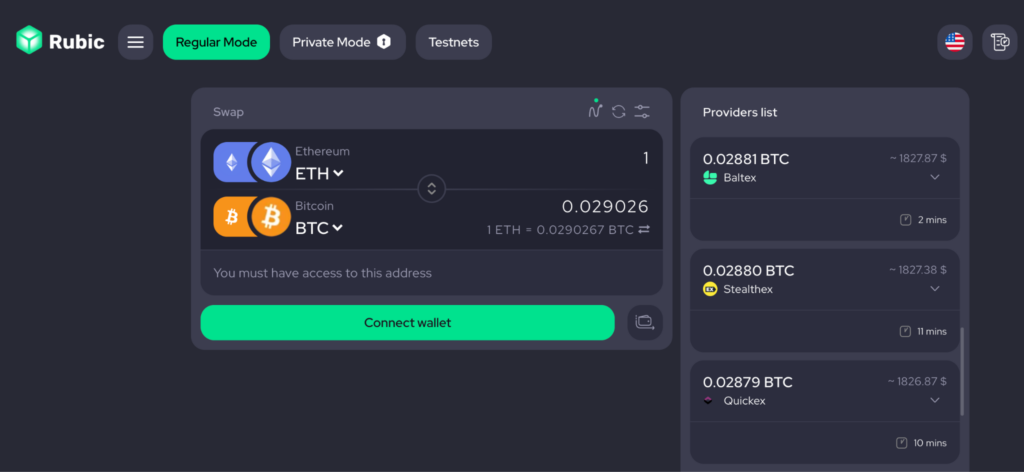
Reach varies enormously between providers
Providers in a routing stack can be compared along four separate axes: liquidity depth, native-asset settlement, long-tail network reach, and custody model. A provider that leads on one usually doesn’t lead on the others, and route availability changes depending on which mix an aggregator has integrated.
Jupiter optimizes for depth. Within Solana it offers the most complete liquidity picture available; outside Solana it offers nothing, and isn’t trying to. Its limitation is its scope.
THORChain optimizes for settlement properties. It handles native asset swaps across UTXO chains without wrapping, which matters where wrapped representations carry risk the user doesn’t want. Its limitation is a restricted set of supported assets and networks.
Baltex optimizes for long-tail reach through deposit-style execution, and its footprint runs almost exactly counter to DEX depth. At the time of verification it exposed routes across the chains where on-chain routing is thinnest — Bitcoin, Monero, Litecoin, Dash, Cardano, Polkadot, XRP Ledger, Tezos, Filecoin, Cosmos, Aptos, Sui, XDC, Tron — alongside the major EVM networks and Solana. On Ethereum or Arbitrum it’s one quote among many, competing on rate. On Monero or Cardano, providers like it are the reason a route exists at all.
As a result, adding a provider can increase the number of answerable pairs without materially improving the best quote on already liquid routes — and the reverse is equally true. Coverage and competitiveness are separate axes, and a provider strong on one is often weak on the other.
What this means for aggregation
An aggregator’s answerable set of swaps is the union of what its providers can do. Adding a DEX aggregator deepens existing routes. Adding a deposit-style provider or an aggregator of them extends reach into chains that had none.
A broader answerable set does not mean all routes are equivalent. A single aggregator may combine on-chain execution, native cross-chain settlement, and deposit-style routes in the same interface, and these differ in custody model and price verifiability, not just in speed and cost. The existence of a route is not the same as the quality of a route, and users comparing options should be able to see which execution model each one uses.
When there’s still no route
Coverage gaps are real and worth being straightforward about. When a route genuinely doesn’t exist:
Check whether an adjacent pair works. Swapping to a major asset on the destination chain and handling the last hop separately often succeeds where the direct pair fails. Rubic suggests an alternative pair when the requested one has no route.
Check your size. Amounts below a provider’s minimum or above its available liquidity fail even where the route is supported. Adjusting the amount sometimes resolves it immediately.
Check the token, not the chain. A token with no meaningful liquidity anywhere can’t be routed by anyone. Confirm it trades somewhere before assuming a coverage problem.
Try again later. Unavailable route requests are logged and reviewed, and provider coverage expands based on what users actually ask for. A pair that fails today may work after the next integration — the requests are the input to that decision.

Marketing specialist with 5+ years of experience and a deep understanding of crypto, AI, market narratives, and industry insights.