

MegaETH: Real-Time Ethereum and What It Means for DeFi

Rubic has been building alongside MegaETH since the early testnet days. Now, as the chain has launched publicly, Rubic’s Best Rate Finder is live on MegaETH from day 1, aggregating multiple provider options for both cross-chain and on-chain swaps.
From day 1, Rubic serves as a gateway into the MegaETH ecosystem, with Warp for on-chain swaps, Relay for cross-chain swaps, and 0% protocol fees on stablecoin swaps.
Now, let’s break down what MegaETH is and why it stands out.
TL;DR
- MegaETH is a latency-first EVM L2, built for real-time execution, not just high TPS.
- Early January 2026 tests show 47K TPS peaks with near-instant confirmations via mini-blocks.
- EigenDA is live and actively used, signaling real data availability demand, not test-only traffic.
- MegaETH’s split architecture (sequencers, executors, verifiers) enables parallel execution, low gas, and low jitter.
- Rubic supports MegaETH from day 1, aggregating swap routes and acting as a gateway into the ecosystem.
- Rubic’s Best Rate Finder API/SDK enables dApps to access the MegaETH mainnet from day 1.
Rubic Best Rate Finder on MegaETH For Users and dApps
Rubic enables swaps on MegaETH through multiple supported providers, offering a streamlined way to compare routes without jumping between different interfaces. Integrated from Day 1, MegaETH is available on Rubic for both cross-chain and on-chain swaps, for users as well as dApp builders.
With Rubic’s Best Rate Finder API, integrators can bring the full routing and rate-comparison logic of the Rubic app into their products through a single, simple integration.
Beyond the technical layer, Rubic provides full pre- and post-launch support. Partners benefit from dedicated account management and private communication channels, as well as marketing and business development support, including warm introductions, social amplification, joint campaigns, and media exposure.
This support can significantly accelerate a dApp’s growth on newly launched chains like MegaETH.
MegaETH Unpacked: The Real-Time Edge
At its core, MegaETH is an EVM-compatible L2 optimized for latency first, not just raw throughput. The long-term target is 100k+ TPS while anchoring back to Ethereum’s security, but the more interesting part is how fast state updates propagate.
MegaETH metrics from January 2026 show peaks of 44K TPS ahead of the “global stress test”, with mini-blocks enabling near-instant confirmations. On the data side, EigenDA is live and consistently posting blobs, reflecting sustained data availability usage rather than one-off testing.
The real takeaway isn’t performance marketing. It’s what this enables. MegaETH is shaping up as a substrate for agentic and reactive DeFi, where strategies can execute in real time instead of waiting on block boundaries. Latency becomes less of an external constraint and more of a design parameter, shifting value toward risk management, coordination, and strategy quality.
How It Differentiates: Beyond the TPS Arms Race
MegaETH’s architecture is where the differentiation becomes tangible. Execution is split across sequencers for ordering, executors for compute-heavy tasks, and verifiers for integrity, allowing parallelism and reducing contention. This design effectively removes the traditional gas bottlenecks that limit complex applications.
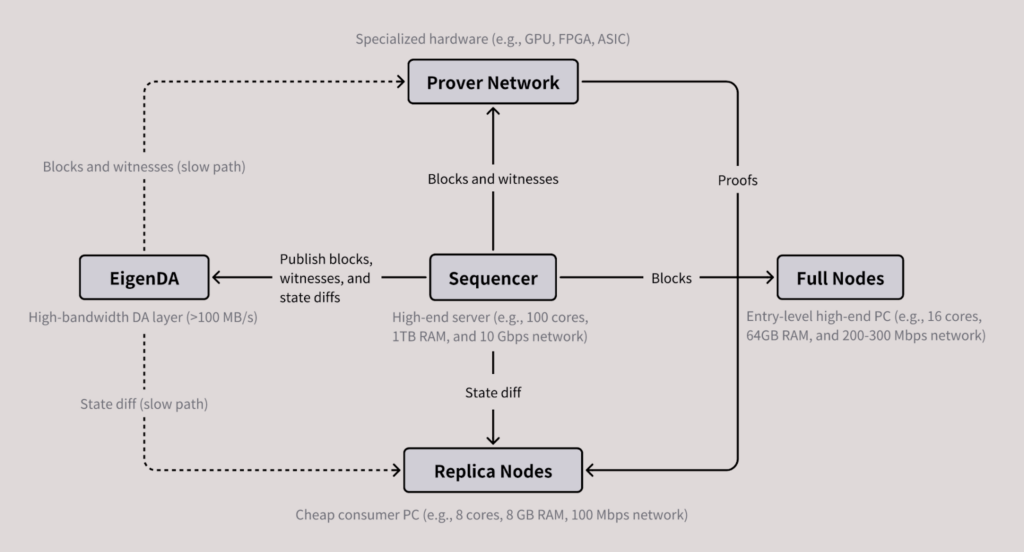
Source: https://www.megaeth.com/research
Compared to rollups like Arbitrum or Optimism, the experience is more predictable. Tests continue to show low, stable gas costs (~$0.0002) and low jitter, which matters for perps, prediction markets, and real-time games where seconds translate directly into outcomes.
DeFi has seen similar patterns before. Base demonstrated that better execution doesn’t just make trading faster, it reduces congestion games and system-wide stress. If MegaETH executes on this consistently, it positions itself as a coordination layer for on-chain finance and AI-driven agents, not just another high-TPS endpoint.
Setup Fundamentals: Bridging Without the Pitfalls
Onboarding remains straightforward, but attention still pays. Add MegaETH to your EVM wallet via official RPCs and confirm network health through uptime dashboards before moving size.
For assets, the canonical path centers on USDC to USDm, MegaETH’s native stable, which is being used to bootstrap early liquidity. As of January 2026, several cross-chain providers have already announced day-1 support for the MegaETH chain, including Wormhole, deBridge, Li.Fi, and Stargate. Meanwhile, Rubic aggregates multiple swap solutions to deliver an ultimate swap experience on MegaETH.
The pattern from past L2 launches still holds. Third-party bridges tend to widen spreads during hype phases. With 100,000+ active addresses, monitoring EigenDA and on-chain activity gives a clearer signal than social volume alone.
First Moves: A Streamlined Playbook
Once bridged, stables like USDm naturally become your anchor. In new ecosystems, they almost always serve as the liquidity nucleus, especially when paired with early programs or yield experiments.
Scan explorers such as Blockscout or Dune for transaction clustering and repeated interactions. Frontier has already logged millions of transactions, enough to distinguish real usage from test noise.
If you’re building, this is where MegaETH feels most distinct. Frontier is explicitly dev-first, and tooling from providers like Chainlink and Alchemy smooths deployment and monitoring. Recent runs suggest that low latency enables compressed execution paths, turning multi-step strategies into single interactions without custody compromises.
Liquidity Dynamics: Where Activity Clusters
Early liquidity predictably follows incentives, but it doesn’t stay there forever. Initial flows are clustering around USDm pools, DEXs like Kumbaya (positioned as a real-time trading superapp), and derivatives venues such as Valhalla, which lean into low-lag perps.
Yield platforms like Brix are gaining traction, while NFTs are already live, with activity appearing on marketplaces such as Magic Eden and OpenSea following January 2026 updates.
The useful signal isn’t which protocol trends first. It’s where transaction density persists. Drawing from launches like Blast, organic hotspots show up in dashboards before they dominate narratives. Faster coordination tightens markets quickly, but it also demands protocols designed to handle rapid feedback loops without cascading failures.
Alpha Projects: Curated Ecosystem Spots
The MegaMafia cohort (20+ projects) is where most early experimentation is concentrated. Notable examples include Capmoney_, which launched its Type III stable cUSD with over $350M supply in January 2026; Kumbaya_xyz, now acting as a primary DEX hub for USDm and ecosystem tokens; and Redstone_defi, whose Bolt oracle feeds went live to support high-throughput price updates.
Gaming is another area showing real-time upside. Stompdotgg is experimenting with fully on-chain PVP mechanics that actually benefit from MegaETH’s execution model, rather than fighting it.
Risk Navigation: Smart Plays in Frontier Chaos
Frontier environments always attract noise. Phishing bridges, fake mints, and spoofed domains are already circulating, including bogus USDm sites. Verification via official channels remains non-negotiable.
The upside is that Frontier’s lack of explicit incentives filters out a lot of low-effort farming. Speed cuts both ways. Mistakes compound faster, but so does learning. Historical parallels from Monad and Berachain suggest durable upside comes from technical delivery and sustained usage, not timing narratives.
Watch verifiable signals: DA usage, transaction consistency, and builder velocity. Those tend to lead price narratives, not follow them.
MegaETH is testing whether real-time execution actually changes DeFi behavior. Follow @megaeth for Frontier updates, keep dashboards bookmarked, and share early observations.
In fast ecosystems, collective pattern recognition is often the real alpha.