

How to Send Crypto Privately in 2026: A Step-by-Step Guide
The mechanics of “sending crypto privately” sound like they should be simple. They aren’t. Privacy in crypto isn’t a setting you flip on, it’s an outcome that depends on which tool you pick, which chain you’re on, which asset you’re moving, and what specifically you’re trying to obscure. Do it wrong and you can spend gas, pay protocol fees, and still leave a visible trail. Do it right and the transfer becomes effectively untraceable.
This guide walks through what “right” looks like in 2026, step by step. It assumes you’re using one of the compliant privacy tools that emerged in the post-Tornado Cash period, Railgun, Hinkal, Houdini Swap, Privacy Cash, or an aggregator, like Rubic’s Private Mode, that routes through them.
Before you start: what does “private” mean for your situation?
Before picking a tool, answer four questions. The answers determine which approach makes sense.
What are you actually trying to hide?
- The sender (who’s paying)
- The receiver (who’s getting paid)
- The transaction amount
- The linkage between two specific addresses
- All of the above
Different protocols address different combinations. Railgun hides all four within its shielded pool. Houdini Swap is strongest at breaking the linkage between two addresses by routing through a CEX. Monero hides everything at the protocol level, but only if both sides of the transaction hold XMR.
What’s the chain pair?
Same-chain privacy (Ethereum → Ethereum, Polygon → Polygon) is the simplest case. Cross-chain privacy (Ethereum → Solana, Arbitrum → Base) is harder because bridging itself is a privacy-leak point. Not every tool supports every chain pair, and the ones that do handle it differently.
That’s exactly what the aggregator solves. Rubic Private Mode is the first privacy solution aggregator that automatically finds compatible privacy providers for your transfer. Instead of searching through protocols manually, simply choose the token and chain you want to transfer from, and Rubic will surface the available routes.
What asset, and how much?
The asset matters because not every protocol supports every token. The amount matters more than people realize: privacy protocols rely on anonymity sets , pools of similar transactions you’re hiding among. Sending an unusual amount through a small anonymity set is statistically de-anonymizable even when the cryptography itself is perfect. Round numbers in commonly-used denominations are safer than unusual amounts.
What’s your time and cost tolerance?
ZK-based shielding has gas overhead and sometimes built-in delays for anonymity-set reasons. CEX-routing has spreads and exchange processing time. Privacy-native chains require holding the privacy asset. Each profile is different.
If you can answer these four questions, the rest of the guide gets much simpler.
Step 1: Pick the right privacy approach for your transaction
Four main approaches exist in 2026. Pick based on the answers above.
- Same-chain shielding via ZK middleware (Railgun, Hinkal, Aztec). Best when sender, receiver, and amount all need to be hidden, and the transaction stays on one chain. Strong cryptographic guarantees. Higher gas costs. The destination address you reveal when you “unshield” still gets exposed, so you typically unshield to a fresh wallet you’ve never used.
- CEX-routed privacy (Houdini Swap and similar). Best when the main goal is breaking the on-chain link between source and destination , especially across chains. Lower gas cost. Introduces CEX trust: you’re trusting the exchange not to log the routing in a way that could be subpoenaed later. Fast.
- Privacy-native chains (Monero). Strongest available privacy because it’s the protocol’s default behavior. But you have to acquire XMR first, the counterparty needs to accept it, and exchange availability is limited in many jurisdictions. Practical for some use cases, impractical for many.
- Aggregator routing (Rubic’s Private Mode). The easiest path because the comparison happens automatically, you specify what you want to do and the aggregator picks the best route across multiple privacy protocols. Good when you don’t want to research numerous interfaces, or when you want cross-chain coordination handled for you. You give up some fine-grained control in exchange for not having to make several separate decisions.
For most users in 2026, the aggregator path is the practical default. The direct-protocol paths matter when you have a specific requirement, maximum anonymity-set size, a particular compliance feature, or you’re building something on top of one protocol.
Step 2: Prepare your destination wallet correctly
This is where most people undermine their own privacy without realizing it. Privacy tools only hide the transaction. If the destination wallet is already linked to your identity, the tool can’t help you.
- Use a fresh wallet for the destination. Not a wallet you’ve used before. Not a wallet that’s ever received funds from a KYC’d source. Not a wallet you’ve ever signed messages with on a Discord server or used as an avatar somewhere.
- Don’t pre-fund it from a known source. If you send 0.01 ETH for gas from your main wallet to “fresh” wallet X, and then receive a private transfer to X, you’ve linked X to your main wallet through the gas funding. The privacy protocol can’t fix this. Either use a privacy tool that includes gas in the shielded transaction, or fund gas through its own private channel.
- Don’t attach identity-linked features. Setting an ENS name on the destination turns it into a publicly-resolvable identity. Same for Farcaster IDs, Lens handles, tipping pages, NFT-as-avatar configurations, and on-chain social profiles. Keep the destination wallet boring and unlinked.
- Don’t post the destination address anywhere. Not on Twitter, not on a forum, not in a public Discord channel, not in a screenshot. Every time the address appears in a public place, it adds a data point that can be used to link the address to an identity later.
The rule: assume someone will try to figure out who owns the destination wallet. Then act accordingly.
Step 3: Execute the private transfer
Now you actually send it. The exact flow depends on the approach from Step 1, but the structure is the same across tools.
How to send crypto privately with Rubic’s Private Mode
If you’ve decided the aggregator path is right for your transaction, here’s what the actual flow looks like in Rubic’s Private Mode end to end. Rubic aggregates 4 privacy protocols for private transfers: Railgun, PrivacyCash, ClearSwap, Hinkal.
- Open Rubic’s Private Mode. Navigate to Rubic and switch into Private Mode from the main interface.
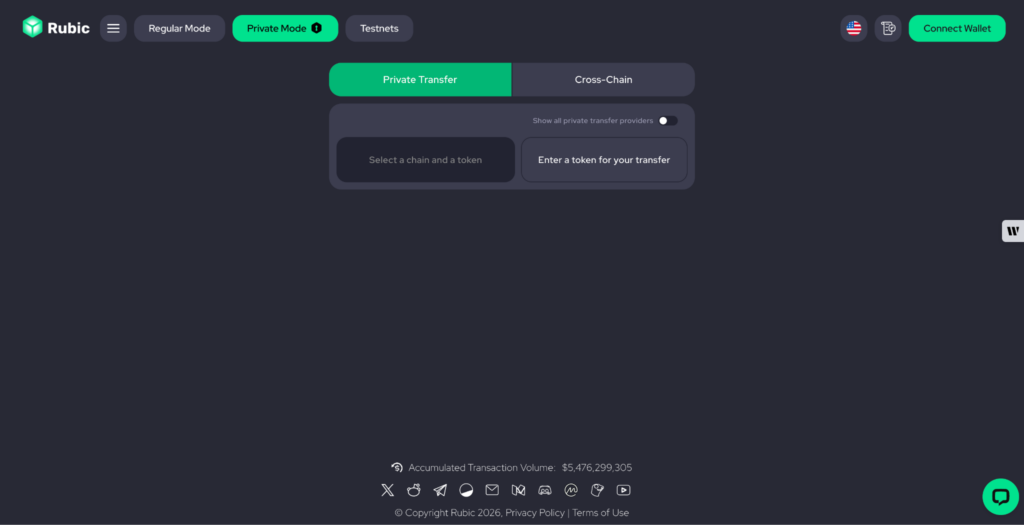
- Pick the token and chains. Select the asset you’re sending, the source chain, and the destination chain.
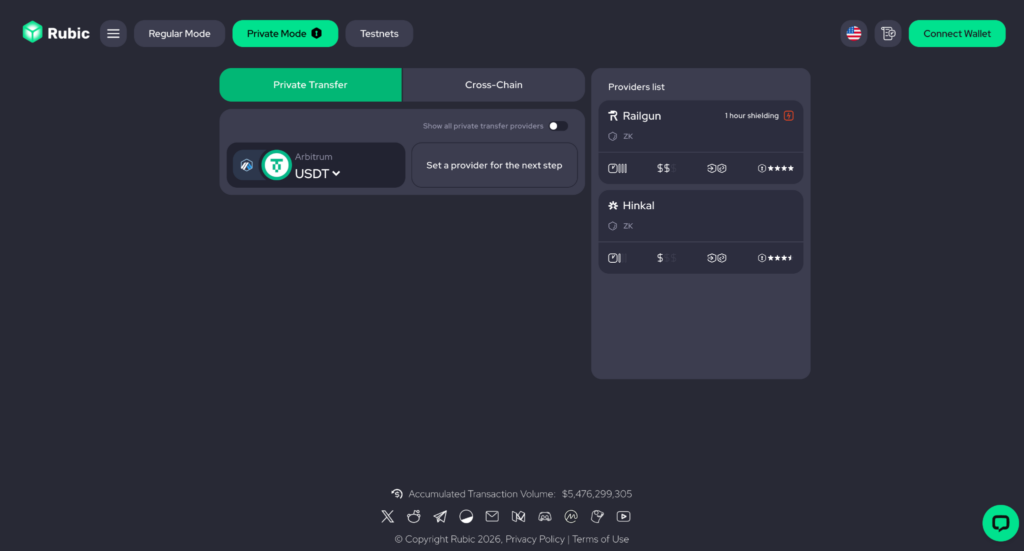
Rubic provides you with the following criteria for each privacy protocol:
- Technology: The underlying technology that makes the solution private. For more details, check out our Privacy Market Overview.
- Time: How long the swap may take. For example, if the scale has three levels, the target action could take up to 1 hour.
- Fees: The cost of the action. More highlighted dollars indicate higher fees.
- Steps to target action: Some providers require extra steps before your swap, such as signing a message in your wallet or shielding tokens. Others let you swap directly. This shows how many actions you need to take before completing the target swap.
- This privacy metric is based on data from the Web3Privacy Explorer: https://explorer.web3privacy.info/
- Let Rubic surface the route. Rubic automatically returns the best supported privacy provider for your specific transaction , based on the asset, chains, amount, and current quotes from each aggregated protocol.
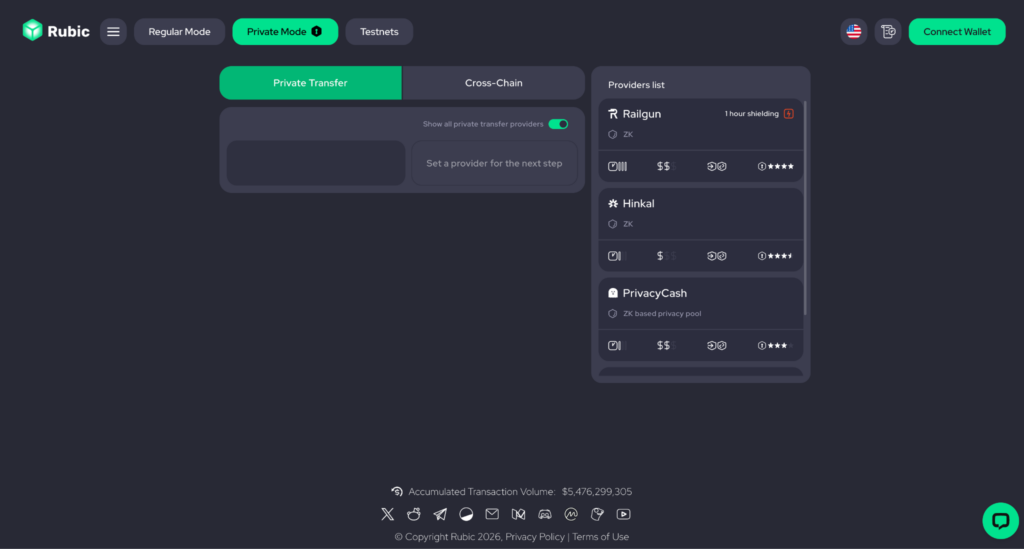
- Optional: see every provider. If you want to compare all the aggregated privacy protocols side by side rather than taking Rubic’s recommendation, click Show all private transfer providers. You’ll see every supported route with its own cost, speed, and privacy properties, and you can pick manually.
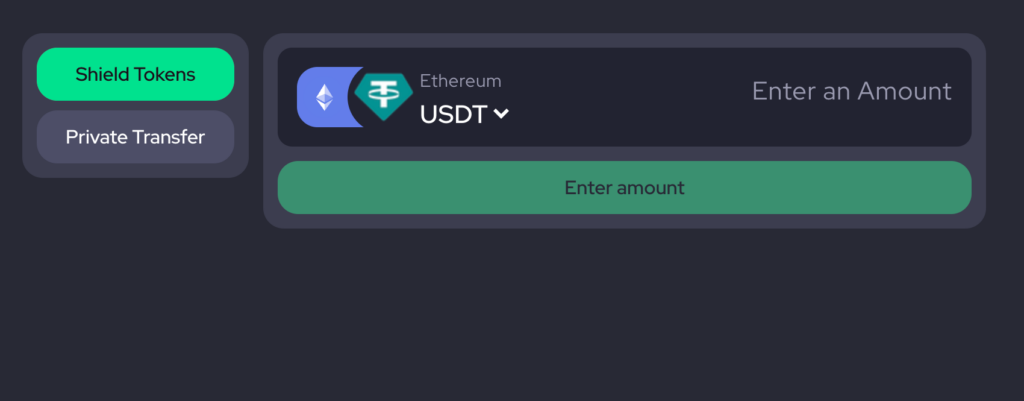
- Shield your tokens. Once you’ve chosen a provider, the first step in the actual transfer is shielding , moving your tokens into the privacy protocol’s shielded layer. This is the moment your funds enter the privacy pool and become unlinkable to your source wallet.
- Enter the destination wallet and send. Paste the destination address (the fresh, unlinked wallet you prepared in Step 2 of the generic guide above) and confirm the transfer. The funds arrive at the destination without an on-chain trail back to where they started.
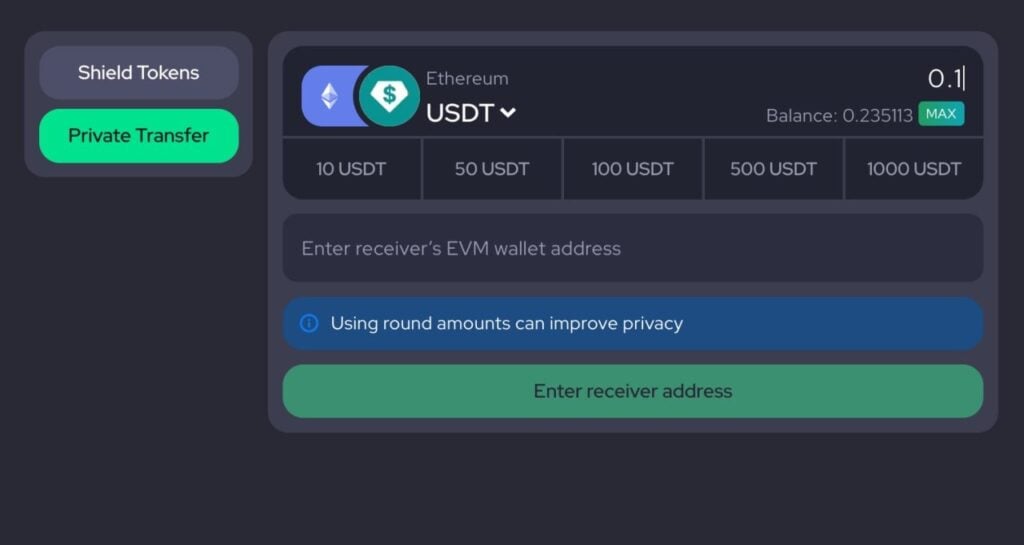
When the transaction completes, the destination wallet receives the funds without a direct on-chain trail back to the source.
Step 4: Verify the privacy actually held
This step gets skipped constantly, and it shouldn’t. Privacy isn’t real until you’ve checked it.
Look up the source address on a block explorer. Etherscan for Ethereum, Solscan for Solana, equivalents for other chains. Find the transaction you just made. What’s visible? You should see a transfer to a privacy protocol’s contract , Railgun’s shield contract, Hinkal’s pool, the routing contract for a CEX-routed service. You should not see a direct transfer to your destination address.
Look up the destination address on a block explorer. It should show an incoming transfer from the privacy protocol’s contract, not from your source address. There should be no single transaction that names both addresses together.
Try to trace the funds yourself. Starting from the source address, using only what’s visible on the block explorer, can you follow the money to the destination? If you can’t, neither can anyone else doing the same exercise. If you can , because you funded gas from a known address, or the timing is unusually correlated, or the amount is a fingerprint , fix it before doing anything else with the destination wallet.
This verification step is the difference between thinking your transaction was private and knowing it was.
What are the most common mistakes people make?
Five mistakes cover most failures. All are recoverable if caught early, harder if caught late.
- Funding gas from a known wallet. The number-one privacy leak. Use a protocol that includes gas in the shielded transaction, or get gas to the destination through its own private channel.
- Reusing the destination wallet. Sending two private transfers to the same destination from two different sources creates a link between the sources. Anyone who deanonymizes one transfer can now reason about the other. Use fresh destinations.
- Disclosing the destination later. Posting the address publicly, tipping with it, signing messages from it, or connecting it to a Discord verification bot , any of these breaks privacy retroactively. The destination has to stay quiet.
- Choosing a protocol that doesn’t match the use case. Using same-chain shielding when the goal was cross-chain linkage-breaking, or using CEX-routing when the goal was hiding the amount. Step 1 of this guide exists to prevent this.
- Sending unusual amounts. Privacy protocols rely on you blending in with other transactions. Sending 7.4318 ETH through a pool that mostly sees 1, 5, and 10 ETH transactions makes you statistically identifiable. Round numbers in commonly-used denominations are safer.
Should you use a privacy aggregator or go direct?
The honest answer: aggregator for most cases, direct when you have a specific reason.
Using a privacy aggregator like Rubic is the practical default because it solves the comparison problem. You specify what you want to send; the aggregator returns route options across multiple privacy protocols with quotes on cost, speed, and privacy properties. You pick. You don’t research six interfaces or maintain separate familiarity with each protocol.
Going direct makes sense when you need something specific. Examples: maximizing anonymity-set size (which might mean going to a specific Railgun pool), a compliance requirement that maps to one protocol’s selective-disclosure features, or building something on top of a specific protocol and wanting consistency.
For a normal user sending a normal private transaction, the aggregator is faster, easier, and at least as private as direct use , sometimes more private, because the routing decision can factor in anonymity-set size as one of the variables it optimizes for.
If you want to try it, start with a small test amount before doing anything important. Walk through the four steps above end to end, do the verification in Step 4, and confirm the privacy held before scaling up.
Open Rubic’s privacy mode → https://app.rubic.exchange/privacy
Frequently Asked Questions
Can I send Bitcoin privately?
Yes, but with caveats. Bitcoin’s transparent UTXO model makes on-chain privacy harder than Ethereum’s. The main paths are Lightning Network (which adds privacy through off-chain channels), CEX-routed services that move BTC through an exchange and back out to a different address, or swapping BTC for Monero and back. Each has tradeoffs. Same-chain shielding tools like Railgun mostly don’t exist for Bitcoin.
How long does a private crypto transfer take?
Typically one to fifteen minutes depending on the tool. ZK-shielded transactions on Ethereum take a few minutes due to proof generation. CEX-routed transfers take two to ten minutes for the exchange leg. Cross-chain private transfers can take longer. Plan for five to ten minutes as a normal expectation.
Is sending crypto privately the same as money laundering?
No. Money laundering is a specific crime involving disguising the proceeds of illegal activity. Using a privacy tool for legitimate purposes , protecting personal financial information, preventing targeted attacks, maintaining commercial confidentiality , is not money laundering, the same way using a private browsing window isn’t fraud. Part 4 of this series covers the legal landscape in detail. This is not legal advice.
Do I need to KYC to use a privacy aggregator?
No. Privacy aggregators like Rubic’s privacy mode are non-custodial and don’t require any account or identity verification. You connect a wallet and send. The aggregator can’t custody or restrict your funds , that’s the whole point.
How much does private crypto sending cost?
Three components: the network’s normal gas fee, the privacy protocol’s fee (usually 0.1–0.5% for non-mixer protocols), and any additional cost for ZK proof generation or CEX spread. Total is typically 0.3–1% of the transaction value plus gas. Aggregators surface this cost up front so you can compare routes before committing.
What’s the best private crypto wallet?
Privacy is about the protocol you use, not the wallet itself. Any normal self-custody wallet , MetaMask, Rabby, Phantom, Backpack , works fine. What matters is which wallets you choose for source and destination, how you fund them, and which privacy protocol you route through. Don’t pay extra for a “privacy wallet” , pay attention to how you use the wallet you already have.
Can someone trace a private transaction after the fact?
With strong protocols and correct usage, no , that’s the entire point of the cryptography. But “correct usage” is the hard part. The most common reason a “private” transaction gets traced later is one of the five mistakes listed above, not a failure of the privacy protocol itself. The verification step matters.

Content Lead at Rubic with a deep dive into Web3 trends, industry narratives, and market analysis